

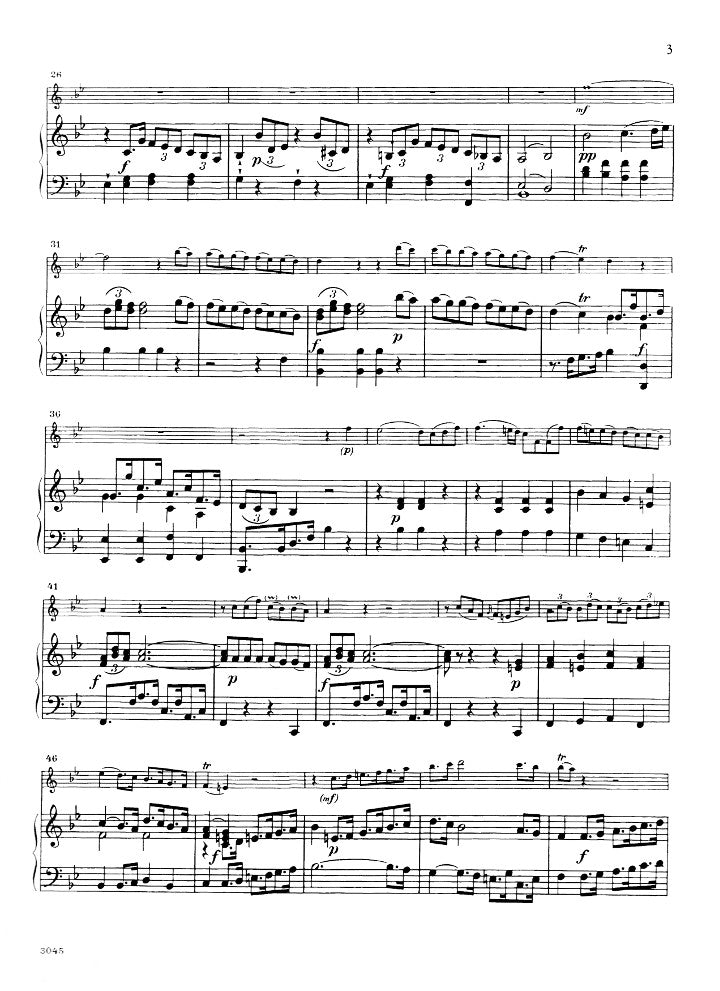
Bach, CPE :: Concerto in B flat Major
Concerto in B flat Major
Bach, CPE
International Music Company presents C.P.E. Bach's 'Concerto in B flat Major' for flute and piano edited by Jean-Pierre Rampal.
'Carl Philipp Emanuel Bach was born in Weimar, the second son by his first wife of Johann Sebastian Bach, then newly appointed Konzertmeister to the Grand Duke Wilhelm Ernst. He attended the Latin School in Cthen, where his father became Court Kapellmeister in 1717, and in 1723 moved with the family to Leipzig, where he became a pupil at the Thomasschule, on the staff of which his father had become Cantor. In 1731 he matriculated as a law student at the University of Leipzig, embarking on a course of study that had been denied his father. He continued these studies at the University of Frankfurt an der Oder, and in 1738, rejecting the chance of accompanying a young gentleman on a tour abroad, entered the service of the Crown Prince of Prussia at Ruppin as harpsichordist. He moved with the court to Berlin in 1740, on the accession to the throne of the Prince, better known subsequently as Frederick the Great. In Berlin and at Potsdam, Bach, confirmed as Court Harpsichordist, had the unenviable task of accompanying evening concerts at which the King, an able enough amateur flautist, was a frequent performer. His colleagues, generally of a more conservative bent, included the distinguished flautist and theorist Quantz, the Benda and Graun brothers and other musicians of similar reputation, while men of letters at the court included Lessing. In 1755 he applied for his father s old position at the Thomasschule in Leipzig, but was unsuccessful, his father s former pupil Doles being appointed in succession to Johann Sebastian s immediate successor, Gottlob Harrer. It was not until 1768 that Carl Philipp Emanuel was able to escape from a position that he had found increasingly uncongenial, succeeding his godfather Telemann as Cantor at the Johanneum in Hamburg, a city that offered much wider opportunities than Leipzig had ever done. He spent the last twenty years of his life there. In Berlin he had won a wider reputation with his Versuch ber die wahre Art das Clavier zu spielen (Essay on the True Art of Clavier Playing) and was regarded as the leading keyboard-player of his day. In Hamburg he continued to enjoy his established position as a man of wide general education, able to mix on equal terms with the leading writers of his generation and no mere working musician. He died in 1788, his death mourned by a generation that thought of him as more important than his father, the latter disrespectfully dubbed the old periwig by his sons. As a composer Carl Philipp Emanuel Bach was prolific, writing a considerable quantity of music for the harpsichord and for the instrument he much favoured, the clavichord. His music exemplifies the theories expounded in his Versuch, with a tendency to use dramatic and rhetorical devices, a fine command of melody and a relatively sparing use of contrapuntal elements that had by now come to seem merely academic. In musical terms he is associated with Lessing s theories of sentiment, Empfindsamkeit, the complement of Enlightenment rationalism. The Concerto in B flat major, Wq.167, opens with a movement that makes much use of triplets and of dotted rhythms. It is followed by a slow movement in which the intensity of feeling is apparent on the entry of the solo flute, with its occasional suggestions of recitative, as in the composer s keyboard sonatas. Dotted rhythms are again a feature of the writing, and there is a solo cadenza before the final section of the movement. The mood changes at once in the lively final Allegro assai, its busy activity at first restrained by the solo flute before going on to rapider passage-work, a process later repeated, as the soloist continues with virtuoso elaboration of the material.'
- Keith Anderson
Eligible online purchases of $199 or more before tax receive free standard shipping within the U.S. Some exceptions apply.
Orders shipped outside the United States do not qualify for this offer.
We're always here for you. If you require product assistance or reccomendations, please open a chat at the bottom right of the page with a resident flutist. Alternatively, you can always contact us at
- Email: info@flute4u.com
- Phone: (972) 985-2662
We do not accept returns or exchanges for accessories like cases, bags, tone enhancers, or cleaning supplies. If an item is defective, you may exchange it for the same product within 10 days of purchase, as long as it's unused and in its original packaging.
Read more about our policies here.
Choose options