


Burnette, S :: Stained Glass Images
Sonny Burnette presents this complete six-movement set of the Stained Glass Images, a major flute choir work for 2 piccolos, 4 c flutes, alto flute, and bass flute, with an optional alternate C flute part in place of the alto.
Based on historic stained glass panels, the Images are deeply programmatic works that span various styles and compositional ideas.
I. The Dawning of the Last Day - The Dawning of the Last Day, 1871, by Frederick AShwin, is the only recordered work by this stained-glass artist in Britain. The pointed-arch window is bordered in rich colors, highlighting a garden valley over which rises a magnificent sunburst in reds and yellows. The spirit of the foreboding subject is captured in the minor tonality and etherial melodic lines. Sunburst spires are depicted with scalar passages in the upper flutes and piccolos.
II. The Rose Window - The rose window was a stained-glass window type which developed from the earlier Romanesque wheel. Typically, the rose window depicts eternity and infinity in perfect symmetry and order, with Christ at its center. Representing the circular window panel is a repeating circle-progression harmonic pattern, producing a chaconne form. Though of contemporary flavor, this movement is suggestive of contrapuntal organ music.
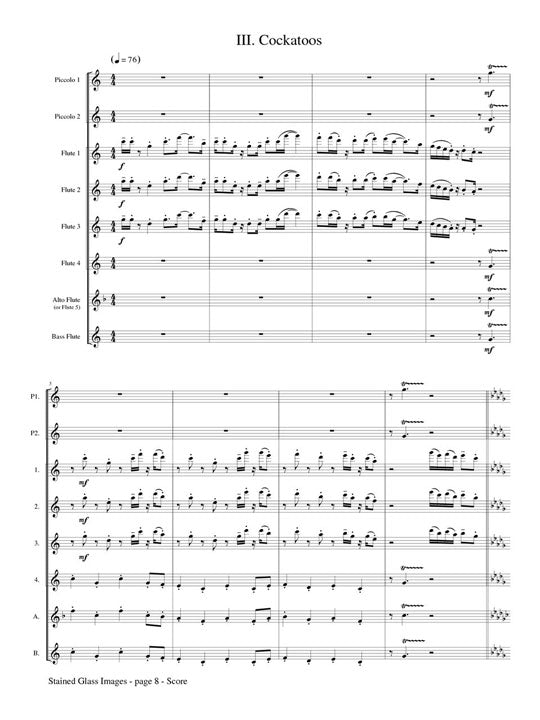
III. Cockatoos - Son of the famous New York jewelry and silverware designer, Louis Comfort Tiffany earned a number of commissions to decorate the houses of the rich and famous, including a commission from President Aruther to decorate the White House. The selected late 19th-Century Tiffany Window depicts two cocaktoos in apolescent white glass in a tropical forest setting. This movement attempts to capture the playful antics of the cokcatoo through syncopated rhythms, close harmonies, trills, and gradually increasing temp.
IV. Two Oriental Panels - In 1888, William Stewart, inspired by the beauty of Japan, designed two panels for the Coll Earn House in Scotland. In the Art Nouveau style, the panels are characterized by swirling asymmetrical naturalism; clean, sinous lines, an exaggerated floral theme, dragonflies, and a soft moonlit ocean. The movement consists of four layered melodic lines, with complex meters and a pentatonic ostinato figure.
V. Colour Tones of Music - Created for the West German Radio Station by George Meistermermann, the huge abstract Colour Tones window caused a great stir when installed in 1952. With a strange mix of color for stained glass (tans, whites, yellow, greens, and blue-grey), the window remains an intriguing art piece. In the movement, middle flute parts procide an ostinato figure suggestive of electronic music, with dissonant parallel melodic harmonies and additional tonal color added vocally by members of the flute choir.
VI. Treasures of the Mediterranean - This captivating modern stained-glass screen by Narcissus Quagliata consists of two panels - on the left an abstract male torso in radiant blue and amber-green with aquatic creatures emerging from points on the torso, and a clenched fist representing Christianity rising from the corrupt Classical world; on the right swirling light blues and greens represent the sea, with a distant image of the planet earth rising above. The movement opens with rising and falling whole-tone scales which portray the aquatic element, with the struggle between good and evil suggested by the martial theme and driving rhythms. As the movement closes the instruments begin to focus on the peaceful aquatic imagery of the second panel before fading away.
Eligible online purchases of $199 or more before tax receive free standard shipping within the U.S. Some exceptions apply.
Orders shipped outside the United States do not qualify for this offer.
We're always here for you. If you require product assistance or reccomendations, please open a chat at the bottom right of the page with a resident flutist. Alternatively, you can always contact us at
- Email: info@flute4u.com
- Phone: (972) 985-2662
We do not accept returns or exchanges for accessories like cases, bags, tone enhancers, or cleaning supplies. If an item is defective, you may exchange it for the same product within 10 days of purchase, as long as it's unused and in its original packaging.
Read more about our policies here.
Choose options