
Debussy, C :: Arabesque 1
Debussy, C
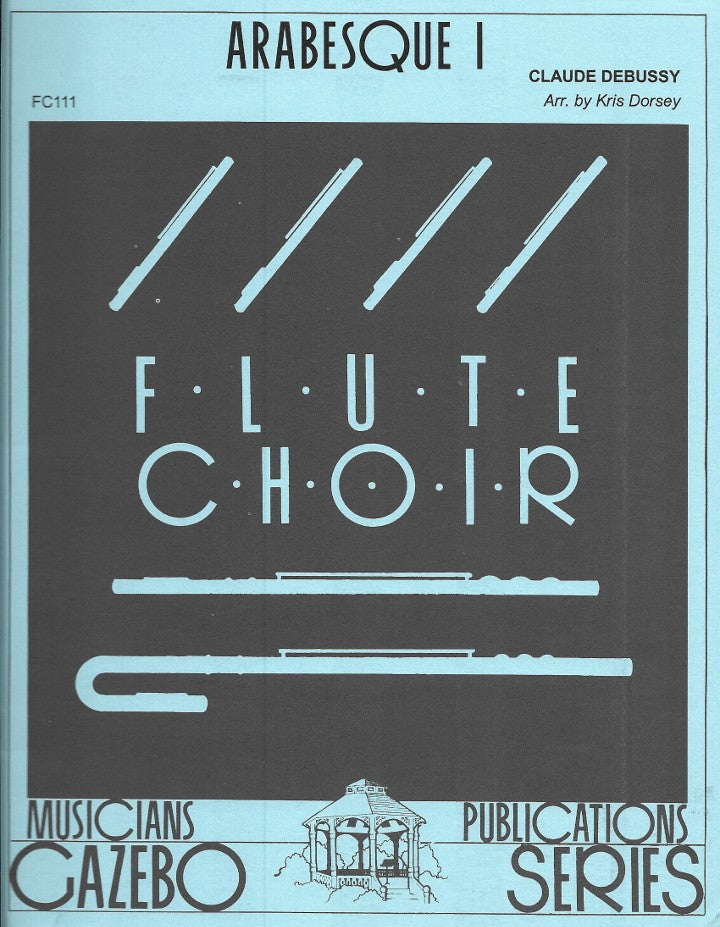
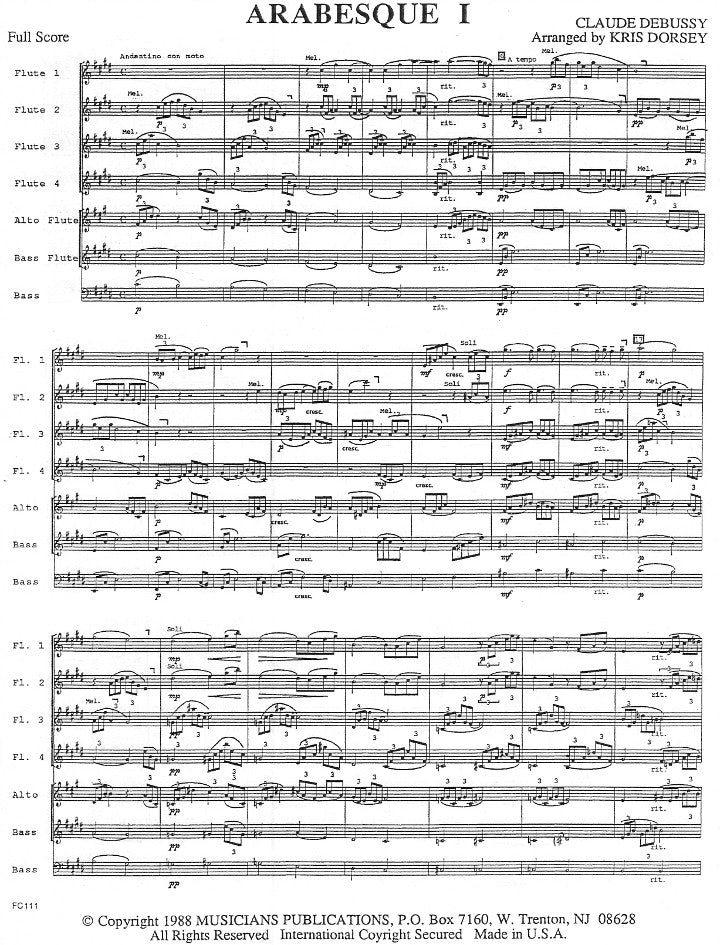
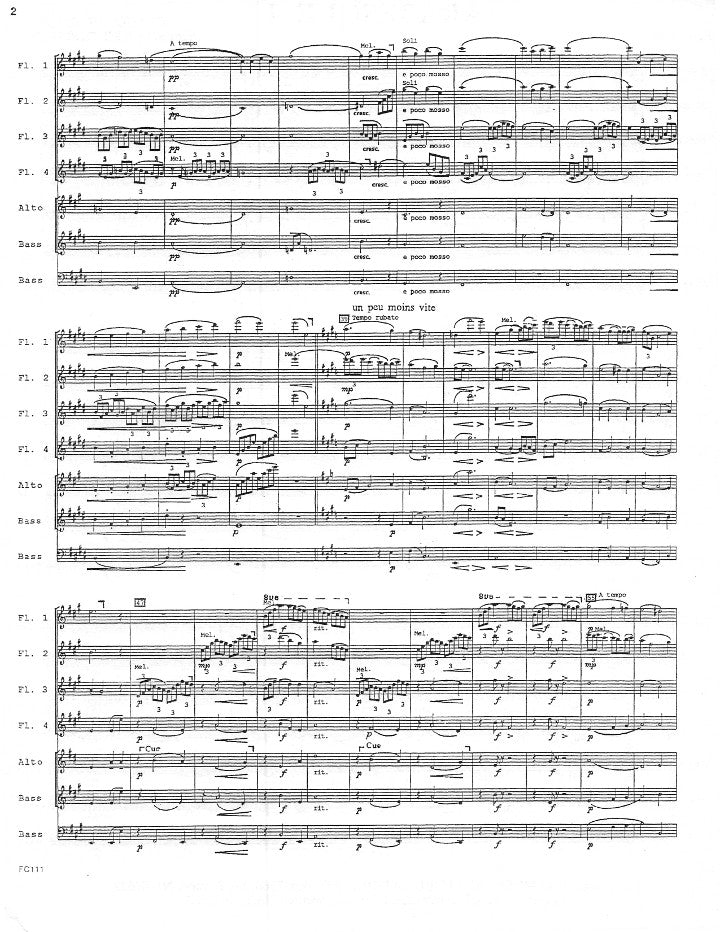
Musicians Publications presents Claude Debussy's Arabesque I arranged for flute choir plus by Kris Dorsey. Scored for 4 C flutes, alto flute, and bass flute, this arrangement also includes optional parts for bassoon or cello to add to the bass sound if desirable.
Claude Debussy was a French pianist and composer, who left a remarkable impact through his compositions. Bela Bartok described Debussy as the greatest composer of our time. Debussy s compositional style utilized aspects of many styles, including French Impressionism, Symbolism, jazz, oriental, and others. Impressionism was a new fad in the visual arts, which blended the colors to give the viewer an impression of the scene, in contrast to a direct, complete image. Debussy writes many of his works in a similar manner, blending the pieces together to make one unique sound. He would often hint of a concept or topic, but he never directly mimics the subject, such as in Voiles .
The title of the prelude Voiles' translates to sails or veils.' Debussy most likely used this word, which has a double meaning to allow the audience to consider their impression of the music. Debussy s title of the preludes are interesting because he did not place the title until the end of the piece because he desired the audience to create their story through their impression of his music. Upon imagining a unique story, listeners would discover Debussy s intentions for the piece.
Debussy expanded harmonic vocabulary and practice of the time by often utilizing ninth and thirteenth chords as well as parallel fifths and octaves. In 1889, Debussy attended the Paris Exposition. This exposition featured art and music from all over the world. Debussy heard the Javanese Gamelan, a type of orchestra from Indonesia, and his music was forever changed. He listened to the scales of this orchestra and began to write with pentatonic scales, whole tone scales, and modes. One may hear these scales throughout Voiles' and hints of the scales in Deux Arabesques . Although Deux Arabesques is one of his earlier works, one may hear his developing style as he experimented with the idea of the arabesque. Arabesques typically contain a rapidly changing series of harmonies that decorate, without furthering, a point in the progress of a composition. Debussy utilizes this musical technique through fluctuating chords and harmonies throughout the piece. Debussy began breaking typical functional harmony progressions by choosing what sounded good for the moment. Debussy s large dynamic range includes a wide range in the quiet level. To play Debussy s works, pianists must vary their touches on the keys to produce the wide variety of colors and tones for the pieces. All of his scores are detailed, and Debussy expected the performers to follow his notations exactly. Debussy s legacy continues today through his compositions.
- Haley Myers, 2014
Eligible online purchases of $199 or more before tax receive free standard shipping within the U.S. Some exceptions apply.
Orders shipped outside the United States do not qualify for this offer.
We're always here for you. If you require product assistance or reccomendations, please open a chat at the bottom right of the page with a resident flutist. Alternatively, you can always contact us at
- Email: info@flute4u.com
- Phone: (972) 985-2662
We do not accept returns or exchanges for accessories like cases, bags, tone enhancers, or cleaning supplies. If an item is defective, you may exchange it for the same product within 10 days of purchase, as long as it's unused and in its original packaging.
Read more about our policies here.
Choose options