
Debussy, C :: Sonata 'No. 4'
Sonata 'No. 4'
Debussy, C
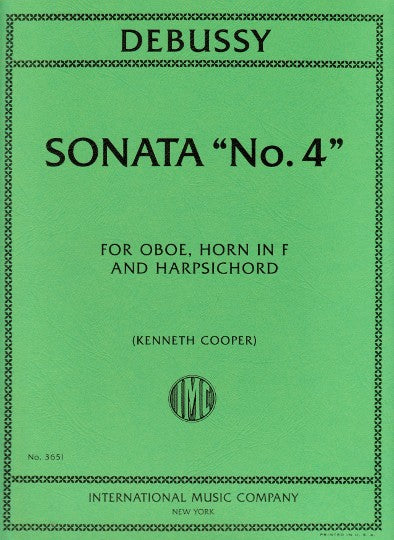
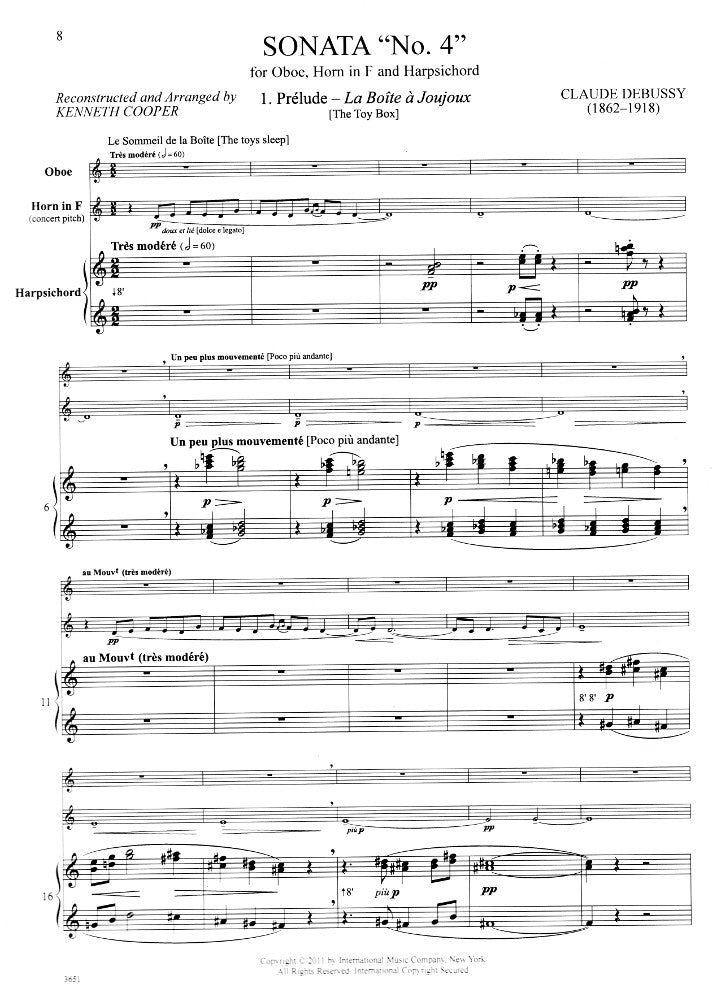
International Music Company presents Claude Debussy's Sonata 'No. 4' scored for oboe (flute), horn in F, and harpsichord; edited by Kenneth Cooper.
Claude Debussy (1862 1918) was a twentieth century French composer and one of the most prominent figures working within the field of impressionist music. Claude Debussy was born into a poor family in France in 1862, but his obvious gift at the piano sent him to the Paris Conservatory at age 11. At age 22, he won the Prix de Rome, which financed two years of further musical study in the Italian capital. After the turn of the century, Debussy established himself as the leading figure of French music. During World War I, while Paris was being bombed by the German air force, he succumbed to colon cancer at the age of 55.
About the piece: 'A very great curiosity about how Debussy's music would have sounded in his projected combination has led to a stab at finding out. Three Debussy pieces have been transcribed to form a plausible, or at least playable 'Sonata No. 4' as some compensation for what the composer might have written in 1918 had he lived. The editor has been guided by the aesthetics especially of the violin and cello sonatas, fitting the present work with a fantasy, scherzo and buffa finale. As Debussy wrote to Poulenc, 'At this moment we should try to regain our old traditions: we have abandoned their beauties, but they are still there.' But which traditions are they? Structurally, Debussy's sonatas spring from Mozartean and Haydnesque models, while instrumentally and ornamentally, the influences seem more Baroque: the concept, if not the content, of Rameau's 'Pieces de clavecin en concerts' (1741) for harpsichord, flute and gamba might have been in his mind. No precedents for Debussy's chosen ensemble seem to have existed, except for a few oboe, horn, and piano works which the composer undoubtedly would have considered too 'grandiloquent.' There are also numerous Baroque works, such as Bach's first 'Brandenburg Concerto' and Handel's 'Water Music', which uses oboes, horns, and harpsichords in combination with other instruments.'
- Kenneth Cooper, 2011
Eligible online purchases of $199 or more before tax receive free standard shipping within the U.S. Some exceptions apply.
Orders shipped outside the United States do not qualify for this offer.
We're always here for you. If you require product assistance or reccomendations, please open a chat at the bottom right of the page with a resident flutist. Alternatively, you can always contact us at
- Email: info@flute4u.com
- Phone: (972) 985-2662
Sheet music, instrument purchases, and Special Order Only (SOO) merchandise are non-returnable.
For other non-instrument merchandise, request return authorization or make an in-person return within 10 calendar days of the original invoice date. Items must be unused, undamaged, in their original packaging with all contents, and accompanied by the original receipt or invoice. Electronic media must be unopened.
Shipped returns require prior authorization. Return Authorizations (RAs) are valid for 10 calendar days from issue. The RA number must appear on the package, and the return must arrive within that period.
Defective merchandise may be exchanged for an identical item if requested within 10 calendar days of the original invoice date. After that period, contact the manufacturer. Please contact us promptly about fulfillment errors.
Read our full Returns & Exchanges Policy for all conditions, return shipping, refunds, and promotional-offer adjustments.
Choose options