
Faure, G :: Morceau de Concours
Morceau de Concours
Faure, G
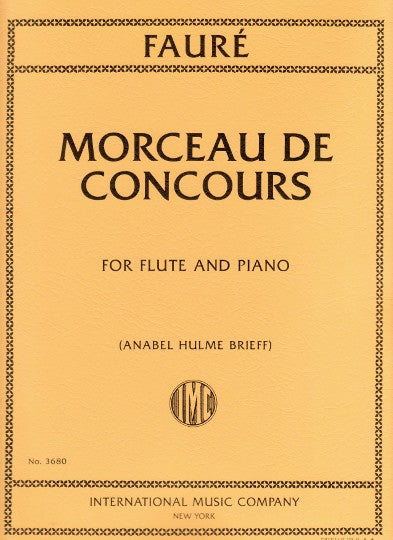
International Music Company presents Gabriel Faure's Morceau de Concours for flute and piano edited by Anabel Hulme Brieff.
'Born in Pamiers, Ariege on May 12, 1845, Gabriel Faure was a French composer, teacher, pianist and organist. He became interested in music at an early age and would often spend hours playing the harmonium in the chapel adjoining the school at which his father worked. An old, blind lady listened to Faure play the harmonium and later told Faure s father of his son s musical gift. As a result his father hired Bernard Delgay as Faure s first music teacher. It was later recommended that he attend the Ecole de Musique Classique et Religieuse in Paris; after some thought, his father agreed that it would prepare him to become choirmaster, so he took Faure there in October 1854. He remained there for eleven years and studied mainly church music, which had a strong influence on his style. Faure is considered to be the most advanced French composer of his generation. He developed a personal style that had a great influence on many early twentieth century composers. Additionally his harmonic and melodic innovations affected the teaching of harmony for later generations.
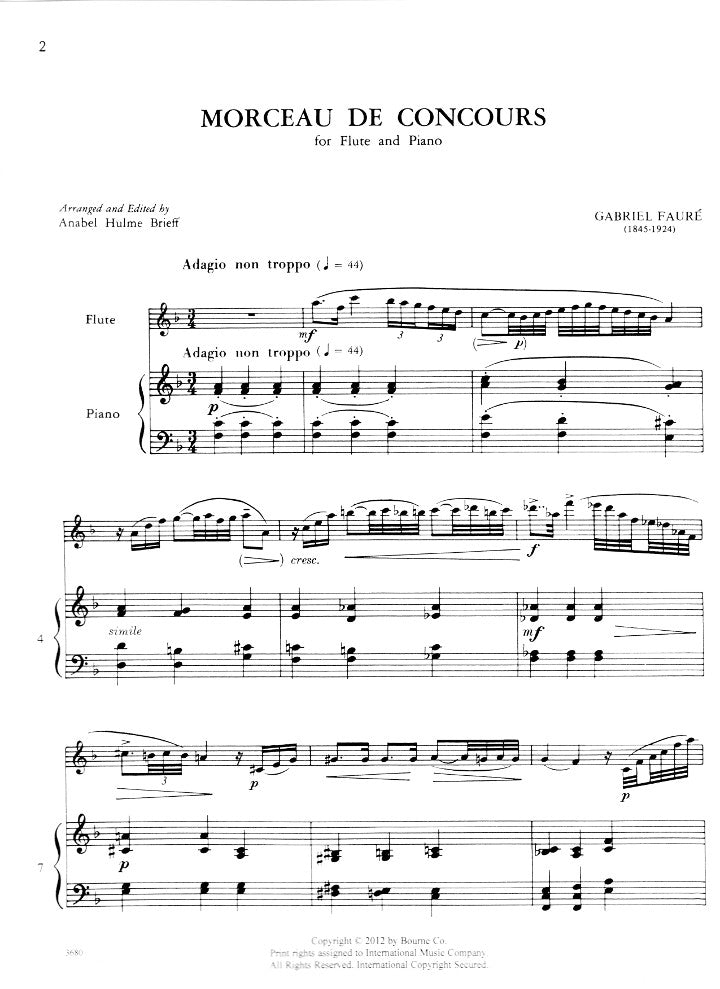
The 1890s are considered to be a turning point in the life and work of Faure as he began to realize some of his ambitions. Morceau De Concours for flute and piano was composed during this transition in 1898. Written as an examination piece for students at the conservatory, the manuscript was lost. In 1970, however, it surfaced in Brussels when the conductor Frank Brieff purchased it from a collector for his wife who was a flutist. The original version of the work was only nineteen bars, but when it was published in 1977 by the Borne Company , dynamics and a fourteen-measure codetta in the middle were added to form an arch with the beginning and the end. Morceau De Concours is a one-movement work with simple, beautiful flowing lines that allows the performer to demonstrate his/her lyrical abilities. The work is in F major and consists mainly of quarter note chords in the piano accompaniment leaving the flutist to be expressive. There are two sections of this work, both of which are very similar. The only difference between these two sections is that the second section begins with mezzo piano whereas the first section begins with mezzo forte. This work evokes a calm and expressive mood.'
- Carey Moore, 2005
Eligible online purchases of $199 or more before tax receive free standard shipping within the U.S. Some exceptions apply.
Orders shipped outside the United States do not qualify for this offer.
We're always here for you. If you require product assistance or reccomendations, please open a chat at the bottom right of the page with a resident flutist. Alternatively, you can always contact us at
- Email: info@flute4u.com
- Phone: (972) 985-2662
Sheet music, instrument purchases, and Special Order Only (SOO) merchandise are non-returnable.
For other non-instrument merchandise, request return authorization or make an in-person return within 10 calendar days of the original invoice date. Items must be unused, undamaged, in their original packaging with all contents, and accompanied by the original receipt or invoice. Electronic media must be unopened.
Shipped returns require prior authorization. Return Authorizations (RAs) are valid for 10 calendar days from issue. The RA number must appear on the package, and the return must arrive within that period.
Defective merchandise may be exchanged for an identical item if requested within 10 calendar days of the original invoice date. After that period, contact the manufacturer. Please contact us promptly about fulfillment errors.
Read our full Returns & Exchanges Policy for all conditions, return shipping, refunds, and promotional-offer adjustments.
Choose options