
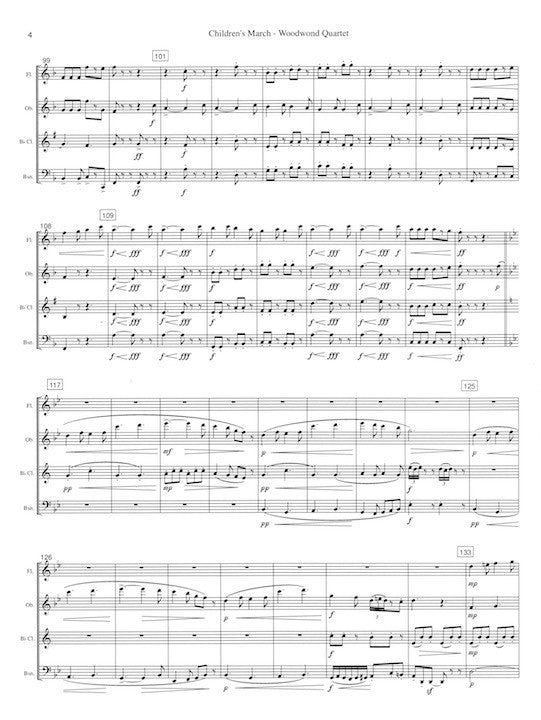
Grainger, P :: Children's March (Over The Hills And Far Away)
Grainger, P
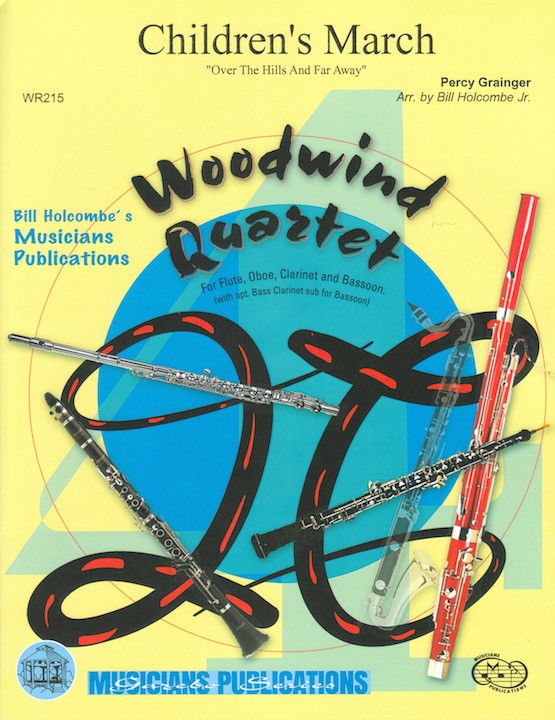
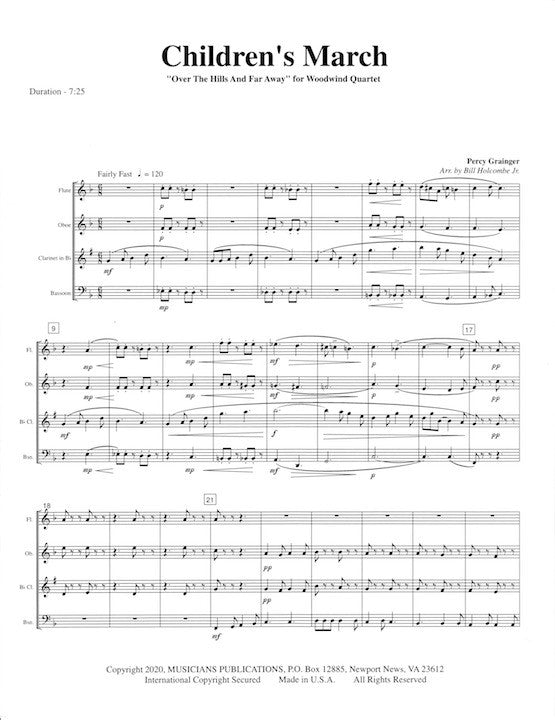
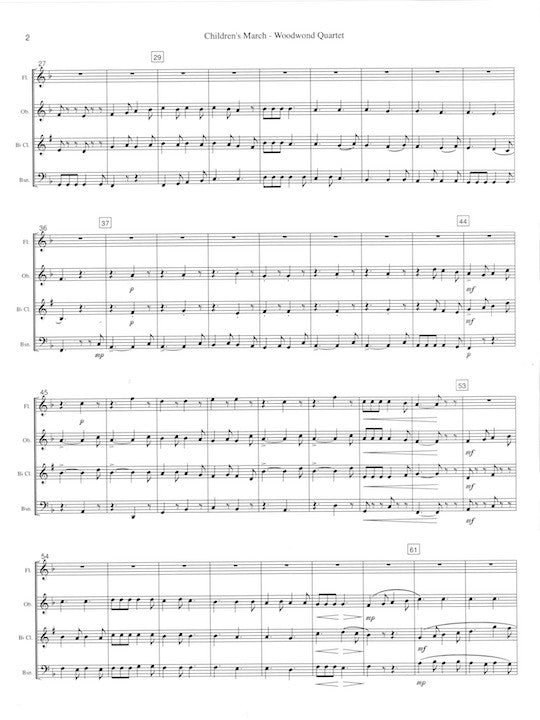
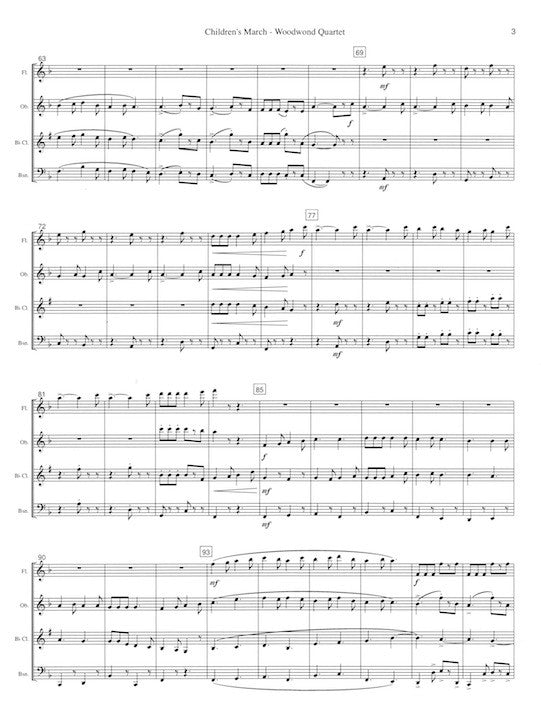
Musicians Publications presents Percy Grainger’s ‘Children's March (Over The Hills And Far Away)’ arranged for woodwind quartet by Bill Holcombe Jr. Scored for flute, oboe, clarinet, and bassoon, this arrangement also includes an optional bass clarinet part to replace the bassoon when necessary. This quartet is advanced in difficulty.
'Although Percy Grainger was born an Australian, he spent the majority of his professional life in England and America. He was an only child, and when his parents separated in 1890, he developed an inextricable bond with his mother that lasted until her death in 1922. She traveled and lived exclusively with Percy, acting as his caretaker, business manager, and closest confidant.Rose Grainger was an accomplished pianist, and young Percy’s earliest musical studies were kept within the family. He showed tremendous promise at the keyboard, and by 1895, he had reached the requisite age of thirteen to enroll in a conservatory. Rose and Percy left Australia for Germany where he was admitted to the Hoch Conservatory in Frankfurt am Main. After his graduation, mother and son relocated to London in 1901 and Grainger began his career as a concert pianist in earnest. During this time he also composed feverishly and began to take particular interest in the native folk songs of his new home. In 1905, he set about in Brigg, Lincolnshire, on the first of what would become countless trips to the English countryside to collect and document the tunes often sung by the native residents. First on paper, and then with the newly developed wax cylinder, Grainger eventually documented more than 700 English and Danish folksongs. He delighted in the nuances and 'imperfections' rendered by each singer and arranged dozens of these tunes for various ensembles. In what would become the defining feature of his work, he not only preserved the tunes, but also the irregular meters and unique interpretations of each singer who first shared the music with him.
After the outbreak of World War I, Grainger moved to New York in 1914 and called America his home for the remainder of his life. He made a triumphant American solo debut in 1915, playing a concert of his own works to a sold- out audience in Aeolian Hall. Celebrated tenor Enrico Caruso was in attendance along with several notable critics, and Grainger was hailed as a modern genius at the keyboard. The Evening Post reported that '...in less than half an hour he had convinced his critical audience that he belongs in the same rank as [Ignacy Jan] Paderewski and [Fritz] Kreisler, sharing their artistic abilities, and yet as unique as they are, something new and sui generis. The audience was stunned, bewildered, delighted.'
Despite his burgeoning success in America, in 1917 Grainger decided to join the U.S. Army in support of the war effort. He served with the Coast Artillery Band until 1919, playing both oboe and saxophone (which he had taught himself to play, among many other instruments). This was Grainger’s first true experience with a concert band, and he was immediately taken with the unique sound of the ensemble. This encounter proved to be the beginning of his long and fruitful relationship with the wind band, resulting in dozens of works that have become the cornerstone of the ensemble’s repertoire. In 1918, the same year he attained his U.S. citizenship, he composed his first original work for band, titled 'Children’s March, Over the Hills and Far Away.'
Most of his works from this period were built upon the folk tunes Grainger had so diligently collected, and the melodies of Children’s March seemingly spring from the same source. However, the work is built entirely upon original material and makes full use of the sonorous capabilities of the band, with special attention given to the double reeds, saxophones, and piano. In fact, Children’s March is believed to be the first original work for concert band with an integrated piano part, complete with the unusual instruction at the very end of the piece that the player hit a string inside the instrument with a marimba mallet. The cheerful romp is dedicated to Grainger’s 'playmate beyond the hills' (whom the composer never identified by name) and was premiered on June 6, 1919, by the Goldman Band with the composer conducting.'
- The President's Own United States Marine Band, 2016
Eligible online purchases of $199 or more before tax receive free standard shipping within the U.S. Some exceptions apply.
Orders shipped outside the United States do not qualify for this offer.
We're always here for you. If you require product assistance or reccomendations, please open a chat at the bottom right of the page with a resident flutist. Alternatively, you can always contact us at
- Email: info@flute4u.com
- Phone: (972) 985-2662
We do not accept returns or exchanges for accessories like cases, bags, tone enhancers, or cleaning supplies. If an item is defective, you may exchange it for the same product within 10 days of purchase, as long as it's unused and in its original packaging.
Read more about our policies here.
Choose options