
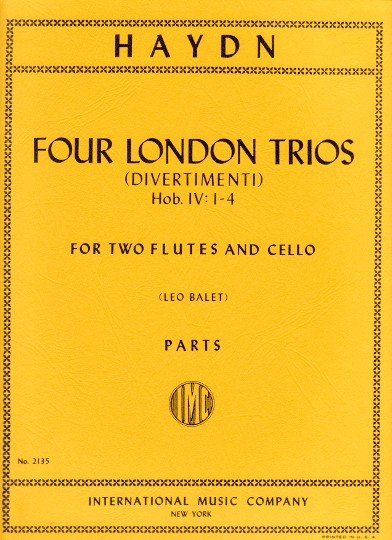
Haydn, J :: Four London Trios (Divertimenti) Hob. IV: 1-4
Four London Trios (Divertimenti) Hob. IV: 1-4
Haydn, J
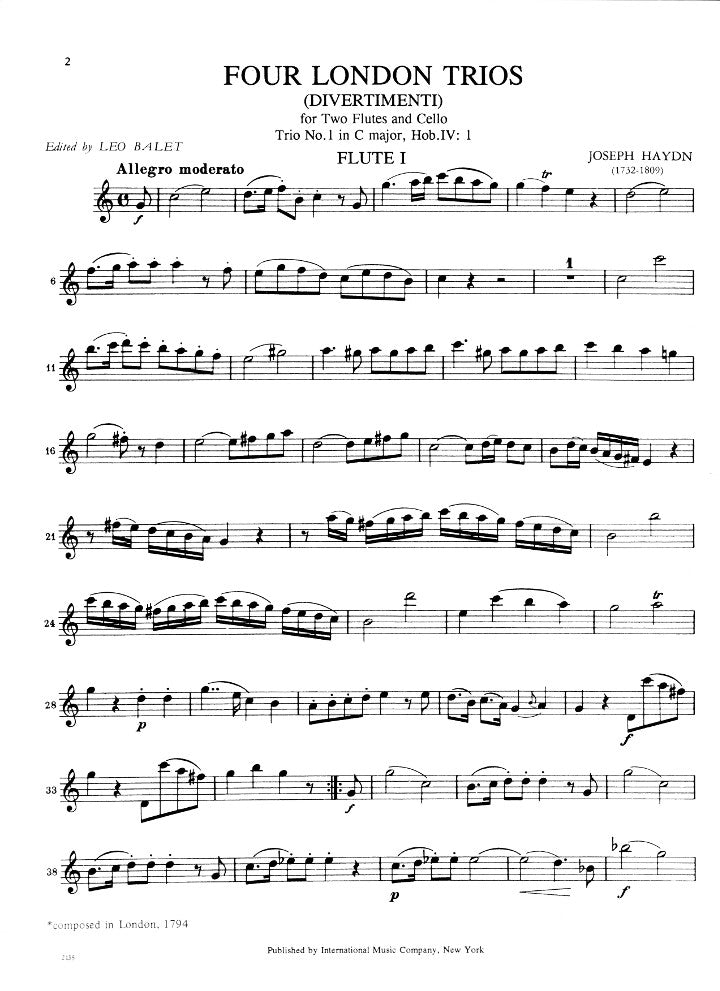
International Music Company presents Joseph Haydn's 'Four London Trios' (Divertimenti) Hob. IV: 1-4 for two flutes and cello edited by Leo Balet. This edition includes parts only.
'Willoughby Bertie, the fourth Earl of Abingdon (1740 1799), was one of Franz Joseph Haydn s leading patrons during the composer s two extended visits to the British capital (1791 1795). He had already helped pave the way for Haydn s great popularity with the London concert-going public throughhis promotion of Haydn s music throughout the 1780s, including two concert series of his own from 1783 to 1784. Lord Abingdon was one of a group of supporters, led by violinist and impresario Johann Peter Salomon, who personally negotiated with the then celebrated composer to lure him to London. A friendship developed between the British noblemanand the wheelwright s son from provincial Austria. Haydn visited Abingdon s estate in the summer of 1794 and accompanied himto Hertfordshire in November. It was for the latter occasion that Haydn wrote a set of four trios, now known as the London trios, for the unusual combination of two flutes and cello. He presented one of the trios to Abingdon and another to his host for the day, Baron Aston. Be fitting the skill set of leisured English gentlemen of the time, both were flute players of some ability. (Abingdon also composed 'miserably,' according to Haydn). The two trios were published and arranged in London a few years later, but all four fell into obscurity until revived early in the last century. They are delightful works. The opening theme of the G-major trio is march-like and carefully designed to allow for an abundance of contrapuntal imitation by all three instruments. Technically, the flute writing would fall within the abilities of the amateur musician, given that flute, together with harpsichord and voice, were the instruments of choice in polite society. As with much music from classicaland Baroque times, the flute line transfers comfortably to violin. The slow movement explores the sonorous, more intimate lower register of the flute. In the finale, it is worth noting the consistent attention to detail Haydn brings to a score essentially designed for domestic music-making.'
- Stanford, 2015
Eligible online purchases of $199 or more before tax receive free standard shipping within the U.S. Some exceptions apply.
Orders shipped outside the United States do not qualify for this offer.
We're always here for you. If you require product assistance or reccomendations, please open a chat at the bottom right of the page with a resident flutist. Alternatively, you can always contact us at
- Email: info@flute4u.com
- Phone: (972) 985-2662
We do not accept returns or exchanges for accessories like cases, bags, tone enhancers, or cleaning supplies. If an item is defective, you may exchange it for the same product within 10 days of purchase, as long as it's unused and in its original packaging.
Read more about our policies here.
Choose options