

Traditional :: Battle Hymn
Traditional
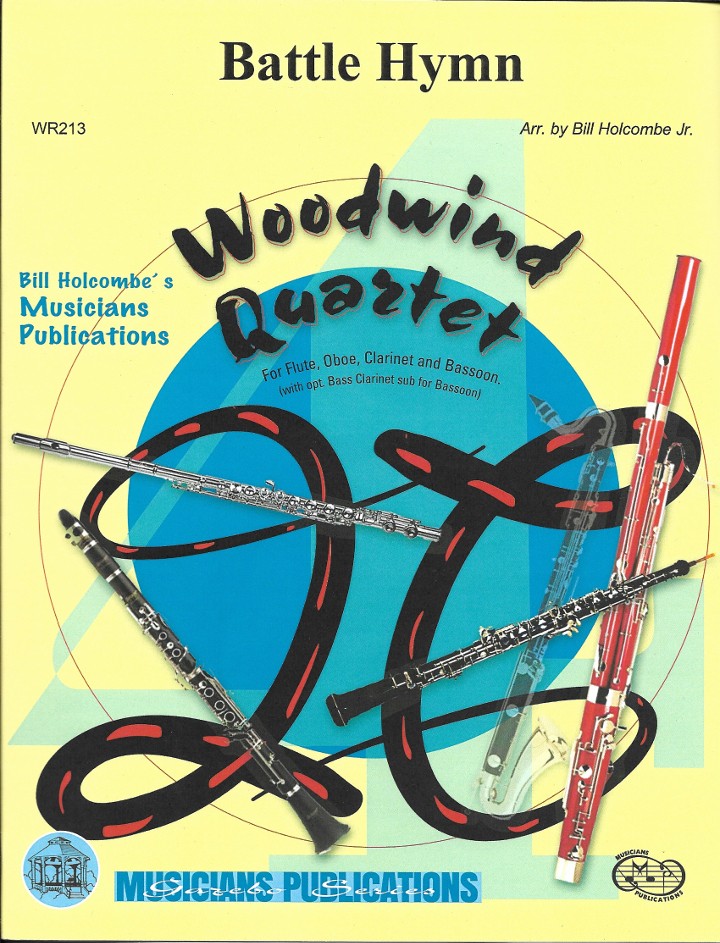
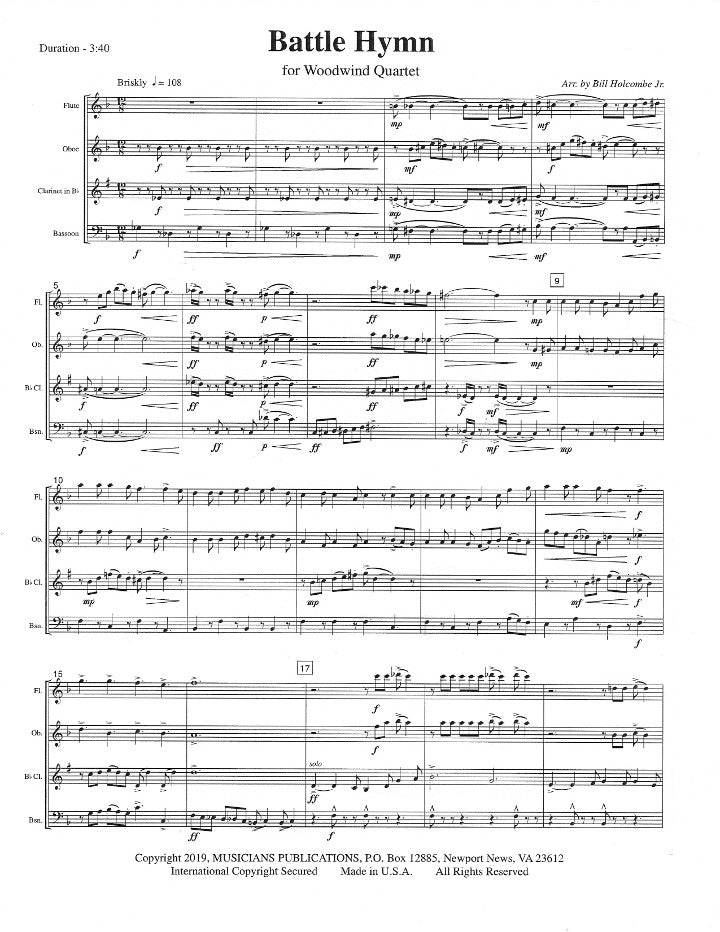
Musicians Publications presents Battle Hymn arranged for flexible woodwind quartet by Bill Holcombe Jr. Scored for flute, oboe, clarinet, and bassoon, this flexible quartet also includes an optional bass clarinet part to replace the bassoon when necessary. This arrangement is intermediate in difficulty.
On November 19, 1861, Julia Ward howe, abolitionist, poet, suffragist and wife of the noted physician and reformer Samuel Gridley howe, witnessed Gen. George McClellan s grand military review in Washington, D.C. Inspired by that patriotic event and by the stirring melody of the marching song John Brown s Body that formed part of its music, Mrs. howe returned to her room at the Willard Hotel and set down some new verses for the melody: Mine eyes have seen the glory of the coming of the Lord. She worked by candlelight through the night, and finished her lyrics at dawn. The poem Battle Hymn of the Republic first appeared in the New York Daily Tribune on January 14, 1862. By the end of the year, it had become one of the most beloved songs of the Union President Lincoln is said to have wept the first time he heard it. The music now associated with the Battle Hymn can be traced to the middle 1850s, when it was widely used as a Methodist camp meeting song under the title Say, Brothers, Will You Meet Us? . Soon after the song was published anonymously in the 1855 hymnal Plymouth Collection', compiled by the well-known abolitionist preacher henry Ward Beecher, the Philadelphia organist and choirmaster William Steffe claimed that he had written the melody, but his authorship has never been proven conclusively. Sometime around 1860, the members of the second battalion of the Boston Light Infantry, Massachusetts Volunteer Militia, fitted Say, Brothers (one of the items in their regular hymn repertory) with new words chiding the battalion s sergeant, John Brown. John Brown s Body proved to be a popular marching song with the 21st Regiment, which used it when receiving the colors on the Boston Common on July 18, 1861 and again a week later in a parade down Broadway in New York while on their way to the battlefields of Virginia. As the song gained greater currency, it became associated with a more famous John Brown the head of the band of abolitionist zealots who raided harper s Ferry on October 16, 1859 and who was hanged six weeks later in Charleston, Virginia. It became the outstanding song of the anti-slavery movement, and inspired many new verses. Julia Ward howe s alone endure. The most familiar symphonic arrangement of Battle Hymn of the Republic is by Peter J. Wilhousky (1902-1978), long-time Director of Music for the New York City Public Schools, an assistant to Toscanini and the NBC Symphony, and a noted lecturer and guest conductor.
- Dr. Richard E. Rodda, 2009
Eligible online purchases of $199 or more before tax receive free standard shipping within the U.S. Some exceptions apply.
Orders shipped outside the United States do not qualify for this offer.
We're always here for you. If you require product assistance or reccomendations, please open a chat at the bottom right of the page with a resident flutist. Alternatively, you can always contact us at
- Email: info@flute4u.com
- Phone: (972) 985-2662
We do not accept returns or exchanges for accessories like cases, bags, tone enhancers, or cleaning supplies. If an item is defective, you may exchange it for the same product within 10 days of purchase, as long as it's unused and in its original packaging.
Read more about our policies here.
Choose options